Artistic Collective Remixes Audre Lorde in New Exhibition
In "To Sew With Anger", an exhibition on view in the Fribourg Family Atrium Gallery through December 6, 2026, Public Humanities grad student Jovanna Walker A.M. '27 collaborated with a collective of local women of color to reimagine the words and work of Audre Lorde.
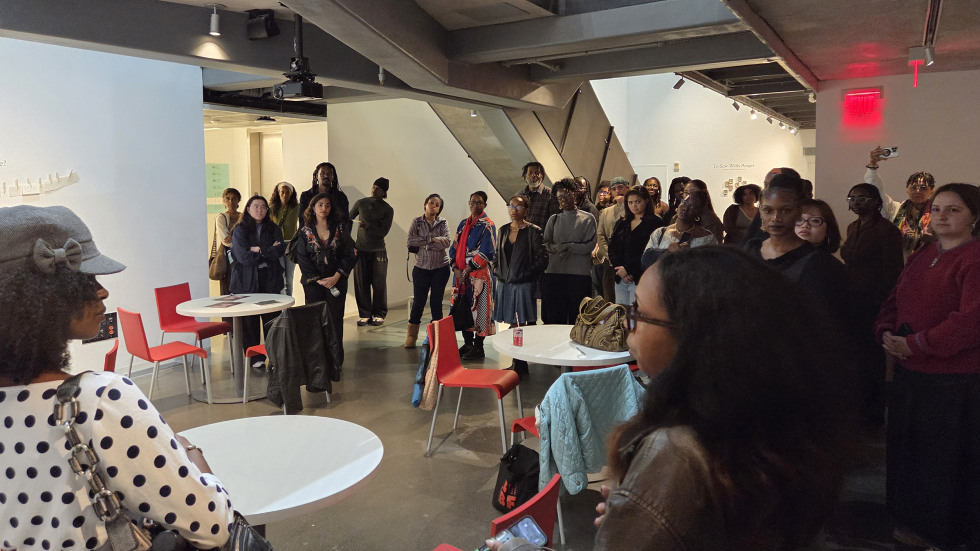
Attendees packed the atrium for a walkthrough of the exhibition on its opening day. Photo by Liliana Guimarães.

The exhibition's major work is a 10' x 5' quilt, which the collective worked on during collaborative sewing sessions. Photo by Laura Kenney.

Attendees of the exhibition walkthrough examined the show's central work: a giant quilt made collaboratively by the artist collective. Photo by Liliana Guimarães.
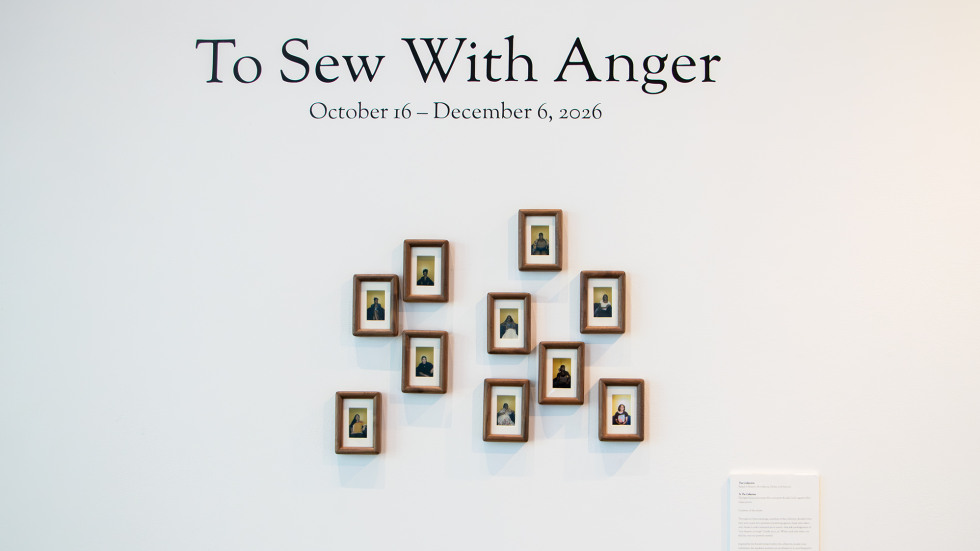
The faces of the collective are on view in the gallery space. Photo by Laura Kenney
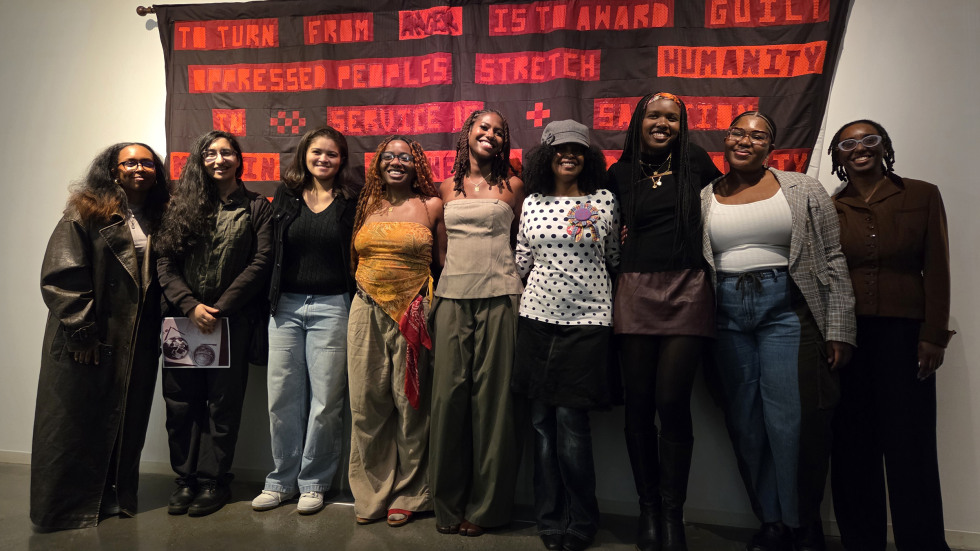
Several members of the artistic collective posed for a photograph in front of their quilt during the exhibition opening. Photo by Liliana Guimarães.
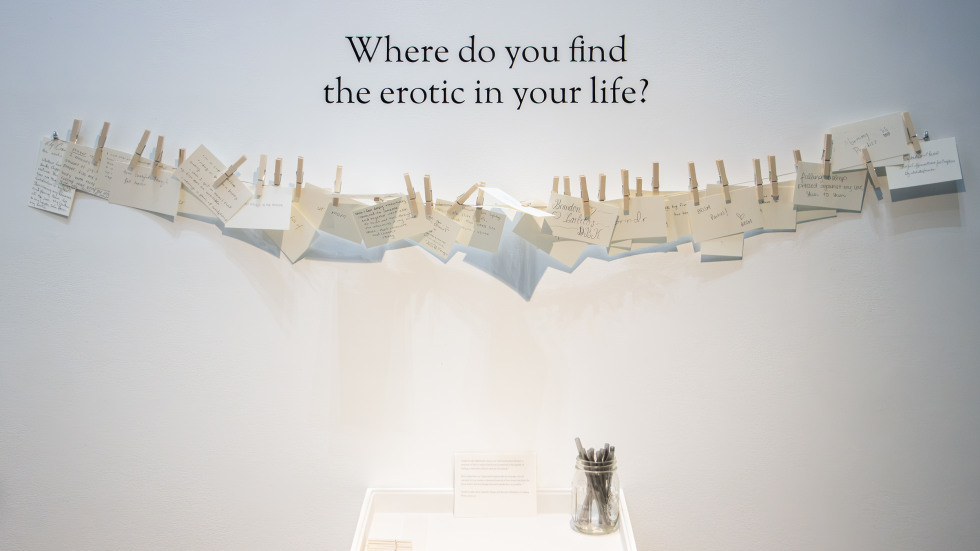
A question posted to the gallery wall invites audience participation. Photo by Laura Kenney

Attendees of the exhibition have left their own reflections within the space. Photo by Laura Kenney
Eroticism, power, anger. These might not be the first things that come to mind when we think about a sewing circle. However, when the needles are handled by a group of ten women of color inspired by self-declared “Black lesbian feminist warrior poet” Audre Lorde, that’s exactly what we get.
Jovanna Walker A.M. ’27 used her Brown Arts Institute Student Grant in the spring of 2026 to mobilize a collective of artists and curators in To Sew With Anger, a three-part project including an Audre Lorde reading club, sewing gatherings to create a roughly 10' by 5' quilt, and an exhibition of the results of this process, now showing at the Fribourg Family Atrium Gallery in the Granoff Center through December 6.
Process is a key word here: from the beginning, the collective knew that the project would culminate in an exhibition. But they didn’t know what that would look like—and that was okay.
“There’s always a push to have a finished, tangible product and move to the next thing, not necessarily thinking about process and care. We felt the need to slow down, and the BAI was really understanding in this sense,” Jovanna says. To Sew With Anger also shows a painting and a cyanotype print by Rania Kadafour, one of the artists in the group, as well as personal photographs and hand-written notes.
The group was interested in discussing anger and the erotic—which Lorde describes as an internal sense of satisfaction, power, and knowledge. Such visceral, intimate feelings might be difficult to articulate. How does a group create space for vulnerability, letting these emotions drive their art? Curator Rejeila Firmin, another member of the collective, notes that gestures of mutual care—constant check-ins, sharing food—can help, and so can the space where these conversations happen. In this case, the collective met at the Simmons Center, which houses the Public Humanities Master’s in Integrative Studies program, a place Jovanna calls her second home. More than anything, however, it was the vulnerability in Audre Lorde’s words itself that motivated the collective to speak openly about these themes.
In the exhibition, visitors are invited to join the conversation: “Where do you find the erotic in your life?” is the intriguing prompt we are asked to answer by writing our thoughts on paper cards and hanging them on the wall with a tiny clothes peg. Responses shared by dozens of previous visitors are there for us to read—as varied as we can imagine, and often inspiring.
When we sew with anger, what comes out of our needles? For this group, the answer is clarity.
Jovanna points out: “This project shifted the way I think about anger. One of the other artists said, ‘we should treat anger as a signpost, and it should give us direction.’” Like the prick of a needle, anger is felt in the body. This same corporeal awareness is brought out by the erotic, that deep manifestation of joy when we engage with our wants and desires.
This is all materialized in the communal quilt now hanging in the Granoff.
As a visitor commented during an exhibition walkthrough: “More than its big dimensions, it’s the story woven into it that’s particularly compelling. It is a blackout poem made out of words and phrases from Lorde’s writing that resonated with the artists, each conveying a distinct emotional weight, depending on the way they chose to sew them.”
Audre Lorde wrote: “Within the celebration of the erotic in all our endeavors, my work becomes a conscious decision—a longed-for bed which I enter gratefully and from which I rise up empowered.” The communal quilt is a beautiful offering to this metaphorical bed, and To Sew With Anger is a much needed reminder of the power of our most intimate emotions.
Learn More
About Behind the Scenes @ BAI
Behind the Scenes @ BAI is the Brown Arts Institute's editorial platform, offering a series of peeks at the art work behind the artworks. BAI presents the culmination of the creative process across many media (the performances, the exhibitions, the screenings), but we also celebrate the evolving, the in-progress, the iterative, and the time, research, and collaboration it takes to bring an idea to life. There's always something happening here: a candid conversation with a visiting scholar, a course visit to a church of robots, a team of specialists reshaping the Main Hall into a whole new venue for the next big show, artists conducting research in the Physical Media Lab. We're here to show you both the method and the madness.
Want to be notified when the latest Behind the Scenes @ BAI features go live? Sign up for our Arts Spotlight newsletter: